
Hand therapy
Objectives of hand rehabilitation
Hand rehabilitation aims to restore the functionality of the upper extremity, to promote mobility, to reduce pain and to improve independence in daily life. It is particularly important after tetra hand surgery procedures and in the case of injuries or conditions that affect the hand, wrist or arm. The focus is on improving motor skills, fine motor skills as well as muscle strength and endurance.
Diagnostic principles and individual therapy planning
The initial situation is comprehensively assessed at the start of therapy. This is done using:
- Medical history and clinical examination: Recording surgical measures, injuries or conditions.
- Functional tests: Assessment of mobility, muscle strength, grip strength, fine motor skills and sensory abilities.
- Pain analysis: Investigation of the cause of pain and its influence on mobility.
- Setting objectives: Definition of individual, patient-specific therapy objectives, such as regaining everyday functions or job-specific requirements.
Treatment approaches and techniques
Hand rehabilitation includes various interdisciplinary approaches in order to ensure restoration of as much function as possible. These are the most important methods at
Activity/participation level:
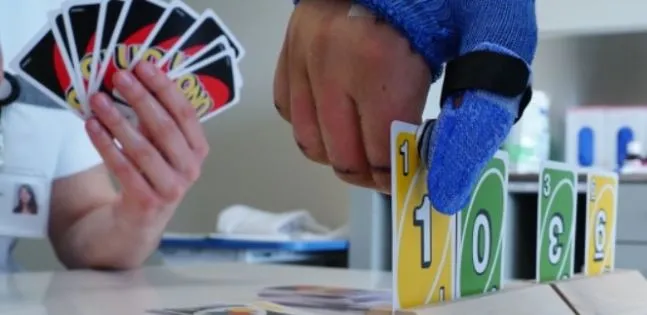
- Training for everyday, professional and leisure activities.
- Training in fine motor skills: Promoting the grip function and dexterity in daily life.
Structural/functional level:
- Manual therapy: Mobilisation of joints, tendons and nerves to improve mobility and relieve pain.
- Motor learning: Following nerve and tendon transfer, it is extremely important to practise the future muscle functions (motor learning).
- Active and passive mobilisation: Exercises to restore the range of movement.
- Strength training: Specific training to strengthen the hand muscles, in particular following muscle atrophy.
- Adaptations and provision of aids: Adjustment of aids to make everyday activities easier.
- Hand splints and orthoses: To stabilise, immobilise or correct misalignments, particularly after operations. Dynamic splints for targeted promotion of certain movements.
- Wound/scar management: Changing dressings after operations, incl. removing stitches. Support with subsequent wound/scar management.
- Sensitivity training: Supporting tactile perception, in particular following nerve injuries or operations.
- Pain management: Use of complementary therapies such as cold/heat treatments, electrotherapy or ultrasound to reduce pain and inhibit inflammation.
- Electrotherapy: Individual electrical stimulation according to the objectives and structural conditions.

Hand Surgery secretary’s office
Werden Sie jetzt Mitglied und erhalten Sie im Ernstfall 250 000 Franken.
Spenden Sie jetzt und unterstützen Sie unsere Projekte zugunsten von Querschnittgelähmten.