
Reconstructing the hand’s grip function
Reconstructing the hand’s grip function is challenging and has to be planned individually for each person living with spinal cord injury. A grip function can be restored using nerve or tendon transfer, or with a combination of both techniques.
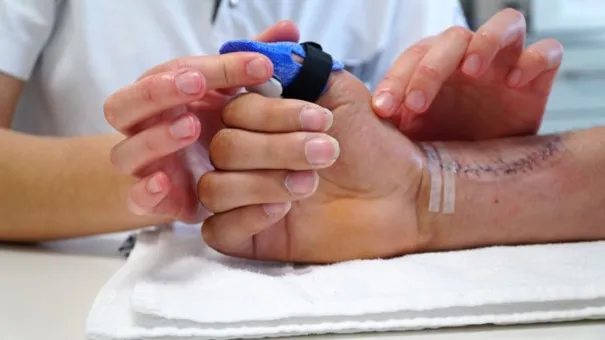
Grip reconstruction using nerve transfer
The following muscles can be reinnervated using nerve transfers: wrist extensors, finger extensors and thumb extensors (hand opening) and finger flexors (bending, particularly the thumb, index and middle fingers).
Requirements
For grip reconstruction, functioning nerves will be required as “donor nerves”. Nerve branches to the brachialis muscle (elbow flexor) and to the supinator muscle (used to supinate the forearm) are usually used as donor nerves.
How are operations performed?
The operation is carried out under general anaesthetic. The donor nerve is located and microsurgical techniques are used to stitch it to the receiver nerves.
What happens after the operation?
The arm that has been operated on will have to be rested for two to three weeks after the operation. Training to learn the new functions (known as motor learning) will be started with guidance from the hand therapists.
What are the chances of success?
The result of the operation depends on many factors, such as the time interval since the accident etc. The nerve fibres grow slowly towards the target muscle, meaning that the first signs of new muscle activity will usually only become visible and noticeable six to twelve months after the operation.
The result of nerve transfer is less reliable than in the case of tendon transfers.
Grip reconstruction using tendon transfer
Tendon transfers can be used to restore the following functions: finger bending, thumb bending and hand opening. Usually, several tendon transfers are combined together in one operation to achieve good hand function.
Requirements
The more donor muscles are available, the better the various movements of the grip function will be able to be restored. The brachioradialis muscle (elbow flexor) or the extensor carpi radialis longus muscle (wrist extensor) are good donor muscles.
How are operations performed?
The operation is carried out under general anaesthetic. The tendons of the functioning donor muscles are transferred to tendons of muscles that are no longer working.
What happens after the operation?
Splint treatment is needed for six weeks in order to protect the tendon stitches. Training for the new functions is started on the first day after the operation with guidance from the hand therapists. The new functions will be visible immediately, but several weeks of training will be needed to integrate the functions into daily life. The hospital stay usually lasts five to six weeks.
What are the chances of success?
Tendon transfers are proven techniques with reliable results.
Werden Sie jetzt Mitglied und erhalten Sie im Ernstfall 250 000 Franken.
Spenden Sie jetzt und unterstützen Sie unsere Projekte zugunsten von Querschnittgelähmten.